What We Know (and Don’t Know)
Dark matter remains one of the most perplexing components of the universe. Although scientists agree on its influence, we still haven’t seen it literally.
The Basics
Estimated presence: Dark matter is believed to make up approximately 27% of the known universe.
Completely invisible: It doesn’t emit, absorb, or reflect light, making it undetectable through traditional means.
How We Know it’s There
Even though we can’t observe dark matter directly, its gravitational effects offer strong evidence of its existence:
We see galaxies rotate at speeds that can’t be explained by visible matter alone.
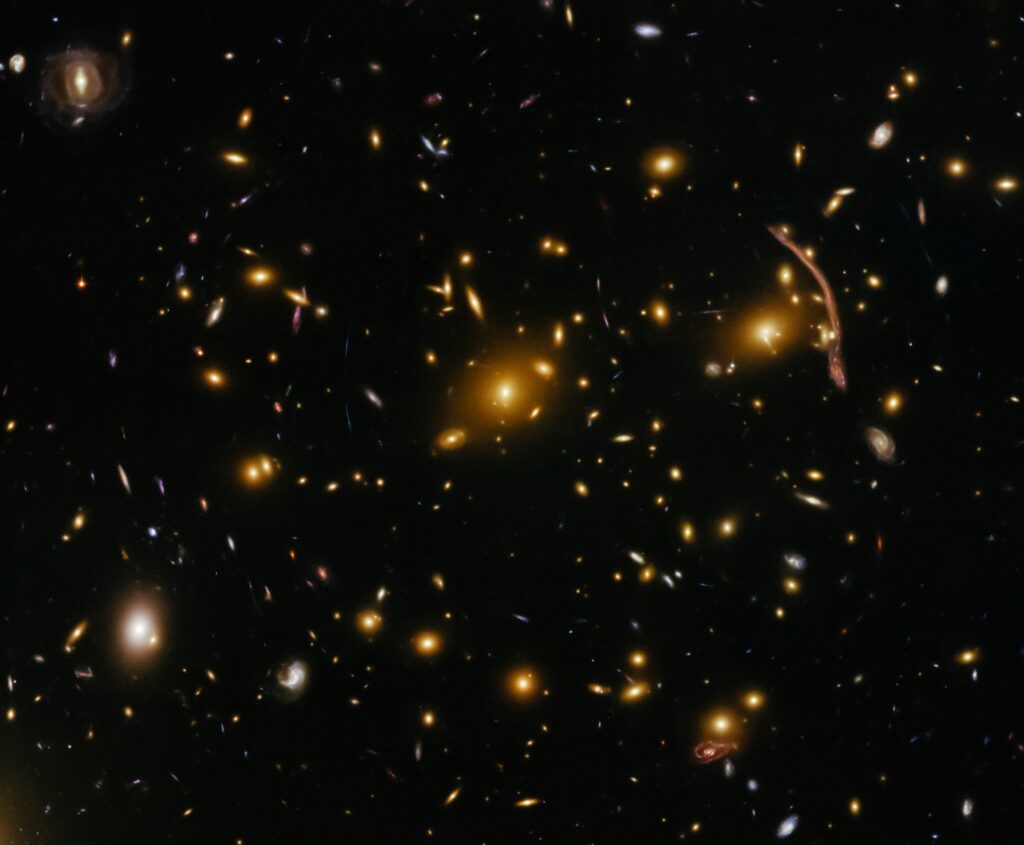
Light from distant objects bends around invisible mass, a phenomenon called gravitational lensing.
The Ongoing Mystery
Decades of research have yielded no direct observation of dark matter.
Instruments continue to improve, but the true nature and composition of dark matter remain unknown.
In other words, we know it’s there. We just don’t know what it is.
The Clues That Keep Scientists Searching
Let’s cut straight to it dark matter doesn’t show up in telescopes, but its fingerprints are everywhere. One of the first and clearest hints came from galaxy rotation curves. In theory, stars on the edges of galaxies should orbit more slowly than those near the center. But that’s not what we see. Instead, outer stars move way too fast fast enough that they should be flung into space if only visible matter held them in. Something extra, something invisible, is adding gravity. That’s where dark matter steps in.
Then there’s gravitational lensing light bending around massive objects. Sometimes the amount of bending doesn’t match the visible matter in sight. In those cases, something invisible is warping space. That invisible mass (again, dark matter) shows up in measurements even when there’s no visible structure to explain it.
We also have evidence from the cosmic microwave background the afterglow of the Big Bang. Tiny variations in this radiation map out the distribution of mass and energy in the early universe. That map clearly shows way more mass than we can see.
Finally, the way galaxy clusters behave seals the deal. Their motions, collisions, and overall structure point to way more mass than just stars, gas, and dust. Together, these clues build a case that’s pretty hard to refute: something big is out there, and it’s not made of the stuff we know.
Competing Theories and Unknowns

For decades, WIMPs Weakly Interacting Massive Particles looked like our best bet for explaining dark matter. They fit neatly into the Standard Model’s extensions and came with clear predictions. But after dozens of experiments and no direct detections, the scientific community is cooling on WIMPs. Promising? Sure. Proven? Not even close.
That’s opened the door for other contenders. Axions, bizarre ultra light particles with origins in quantum theory, are gaining momentum. Sterile neutrinos, an elusive type of neutrino that could interact only through gravity, are also on the radar. And some physicists are ditching the particle idea entirely, exploring theories of modified gravity that might explain away dark matter without invoking anything new at all.
Here’s the wildcard: dark matter might not be one thing. It could be a cocktail of particles or phenomena we’re not yet equipped to see or define. Or maybe, the frameworks we’re using our equations, our instruments, even our assumptions are off base. It’s humbling, but also a spark: not knowing is fuel for discovery.
For a deeper dive into how these ideas collide and evolve, check out dark matter insights.
The Tech Behind the Hunt
When it comes to dark matter, science isn’t short on theories it’s short on evidence. That’s where today’s advanced tools step in.
Detectors like LUX ZEPLIN and XENONnT operate deep underground, shielded from background noise and cosmic rays. These machines are built to spot the rarest of events: a dark matter particle bumping into ordinary matter. They haven’t had a confirmed hit yet, but they’re narrowing the field, helping rule out entire classes of particles.
Then there’s CERN’s Large Hadron Collider. By smashing particles together at near light speeds, it recreates conditions just moments after the Big Bang. Scientists watch to see if any strange remnants hint at dark matter or something even stranger. The collider hasn’t handed us the smoking gun either but it’s revealing what’s not there, and that’s just as useful.
Meanwhile, space telescopes are quietly rewriting our models. Missions like Euclid and the James Webb Space Telescope are gathering ultra precise data about how galaxies form, cluster, and evolve. That information lets scientists reverse engineer where dark matter must be and what properties it might have. Simply put: space is doing surveillance.
None of these technologies are silver bullets, but together, they’re tightening the net. It’s slow work, but dark matter won’t stay hidden forever.
Why Dark Matter Matters
Dark matter isn’t just some missing piece it’s the scaffolding that holds up the whole structure of the universe. Without its gravitational pull, galaxies wouldn’t form or stay together the way they do. They’d fly apart. Spiral galaxies, in particular, don’t make sense without a hidden mass holding them in place.
Mathematically, it’s a problem too. When scientists add up all the observable matter stars, gas, dust it comes up short. Way short. The gravitational effects we see on cosmic scales demand more mass than what we can detect directly. That gap isn’t just inconvenient. It breaks the models. Without dark matter, the equations don’t balance, and our frameworks for understanding cosmic history fall apart.
Then there’s the physics. If we ever figure out exactly what dark matter is, it could shake up the Standard Model the baseline for how we think matter and forces behave. Whatever dark matter is made of, it’s outside the list of particles we’ve confirmed so far. Finding it could expand our fundamental understanding of the universe, or even force a rewrite of what we thought was settled law in particle physics.
The Bigger Picture
Dark matter is frustrating. It dodges detection, skews data, and refuses to play by the rules. But in that stubborn silence, there’s potential. Every unanswered question doesn’t close a door it cracks open a bigger one. Understanding galaxies without understanding dark matter is like trying to build a puzzle with a quarter of the pieces missing.
This isn’t just a scientific curiosity. It challenges what we think we know about the universe. If dark matter isn’t made of the particles we expected, maybe the universe itself isn’t structured the way we assumed. Maybe gravity doesn’t work the way our equations claim. In short, the mystery isn’t an obstacle. It’s fuel. A provocation that keeps science moving, testing limits, and rewriting old truths.
For those ready to follow that thread even deeper, explore more on universe exploration.