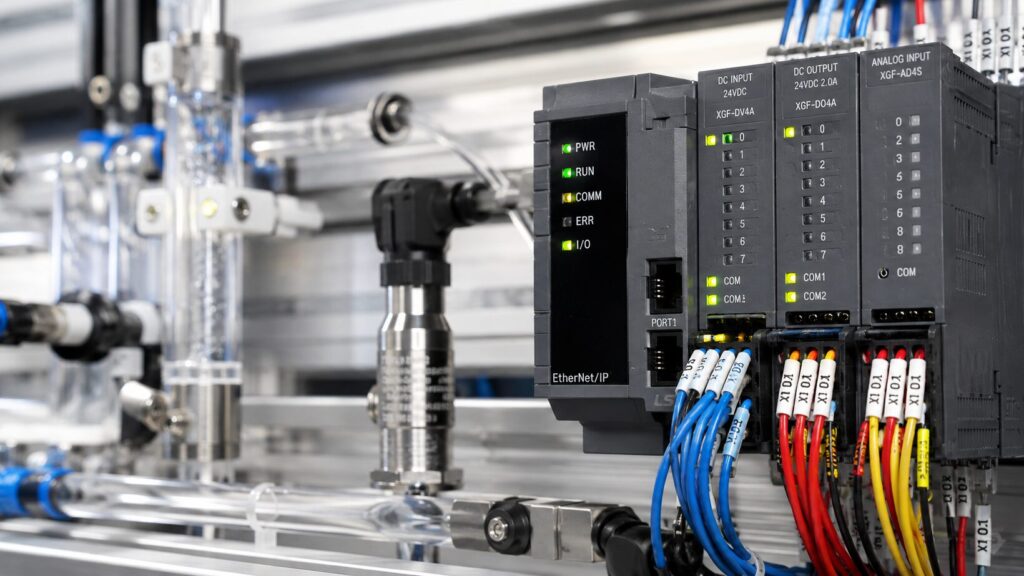
To bridge this “simulation-to-reality” gap, engineering and data science faculties require physical, research-grade infrastructure capable of generating complex, real-world data streams. Utilizing a physical PLC process control workstation as a data-generation engine allows researchers to validate time-series analytics, test edge-computing architectures, and benchmark machine learning models against classical control loops under genuine operational conditions.
1. The Industrial Data Dilemma: Noise, Drift, and Non-Linearities
In theoretical data science, time-series data is often assumed to be stationary or subject to predictable, Gaussian noise. The reality of industrial process loops—governed by variables such as fluid dynamics, thermal inertia, and pressure differentials—is far more chaotic.
When streaming data from a physical process loop via industrial protocols like Modbus TCP/IP or OPC UA, data scientists must account for several physical phenomena that simulations fail to capture:
-
Sensor Drift: The gradual degradation of calibration over time, which machine learning models must distinguish from actual process anomalies.
-
Hysteresis and Stiction: Mechanical friction in automated valves that creates delayed or non-linear responses in flow and level data.
-
Thermal Inertia: Delayed temperature responses that introduce complex lag factors into time-series forecasting models.
Without physical hardware to generate these nuanced datasets, data science models remain unequipped for the realities of modern manufacturing. A physical workstation provides the raw, unpolished data necessary to train robust neural networks capable of operating in imperfect environments.
2. Benchmarking Machine Learning Metrics Against Physical Truth
When implementing unsupervised learning models—such as Autoencoders or Isolation Forests—for industrial anomaly detection, the ultimate metric of success is the model’s ability to minimize false positives while maintaining a high detection rate. In a laboratory setting equipped with industrial standard controllers, researchers can intentionally introduce physical disturbances or hardware faults (e.g., pump cavitation or pipe blockages) to evaluate model performance.
In these validation scenarios, the evaluation relies heavily on calculating the Mean Squared Error (MSE) of the reconstruction data stream. The mathematical expression used by data pipelines to track this error across “n” data points is:
MSE = (1 / n) * Summation of (Actual Value – Predicted Value)^2
By observing how the MSE spikes during real, physical fault scenarios on a control workstation, data scientists can establish precise threshold limits for predictive maintenance algorithms. This empirical validation transforms a theoretical data model into an industrially viable solution.
3. Architecture of an Intelligent Industrial Data Pipeline
Deploying data science models onto the factory floor requires a multi-layered cyber-physical architecture. The process cannot rely on a single software layer; instead, it demands seamless communication between physical instrumentation, edge hardware, and analytical software.
A standard research configuration utilizes a modular platform, such as those engineered by EDIBON, to establish a clear data pipeline:
-
The Physical Layer: Sensors measure real-time parameters (flow rate, temperature, tank level) and transmit analog or digital signals.
-
The Control Layer: An industrial Programmable Logic Controller (PLC) handles deterministic, real-time control loops using classical proportional-integral-derivative (PID) laws.
-
The Acquisition Layer: A SCADA (Supervisory Control and Data Acquisition) system logs the data at high sampling frequencies, serving as the interface between operational hardware and the data pipeline.
-
The Analytics Layer: The logged data is ingested into Python, R, or cloud-based environments via API connectors to execute inference models or update neural network parameters.
This structured environment allows university researchers to study data latency, packet loss, and the computational overhead associated with running inference models directly at the industrial edge.
4. Advancing Graduate Research and Academic Accreditation
For tier-one engineering and computer science faculties, the acquisition of multi-disciplinary laboratory hardware is directly tied to research output and institutional accreditation. Frameworks such as the Accreditation Board for Engineering and Technology (ABET) heavily emphasize the development of measurable, practical competencies in data collection, experimental design, and modern tool usage.
By moving away from static software toolkits and integrating a physical control workstation into the curriculum, universities allow graduate students to engage with true Industry 4.0 paradigms. Doctoral candidates can develop novel algorithms for predictive maintenance, system optimization, and cyber-security in industrial networks, publishing papers backed by empirical evidence rather than purely mathematical assumptions.
5. The Cyber-Physical Convergence
The future of industrial efficiency does not lie exclusively within the domain of the data scientist, nor does it belong solely to the classical control engineer. It exists at the intersection of both fields. The optimization of complex manufacturing loops requires sophisticated data analytics, but those analytics are useless without a deep, empirical understanding of the physical systems they monitor.
By utilizing a high-fidelity PLC process control workstation as an experimental testbed, academic and research institutions can effectively bridge the divide between digital code and physical matter. This approach ensures that the machine learning models developed today are rugged enough to handle the chaotic, non-linear realities of the industrial world tomorrow.